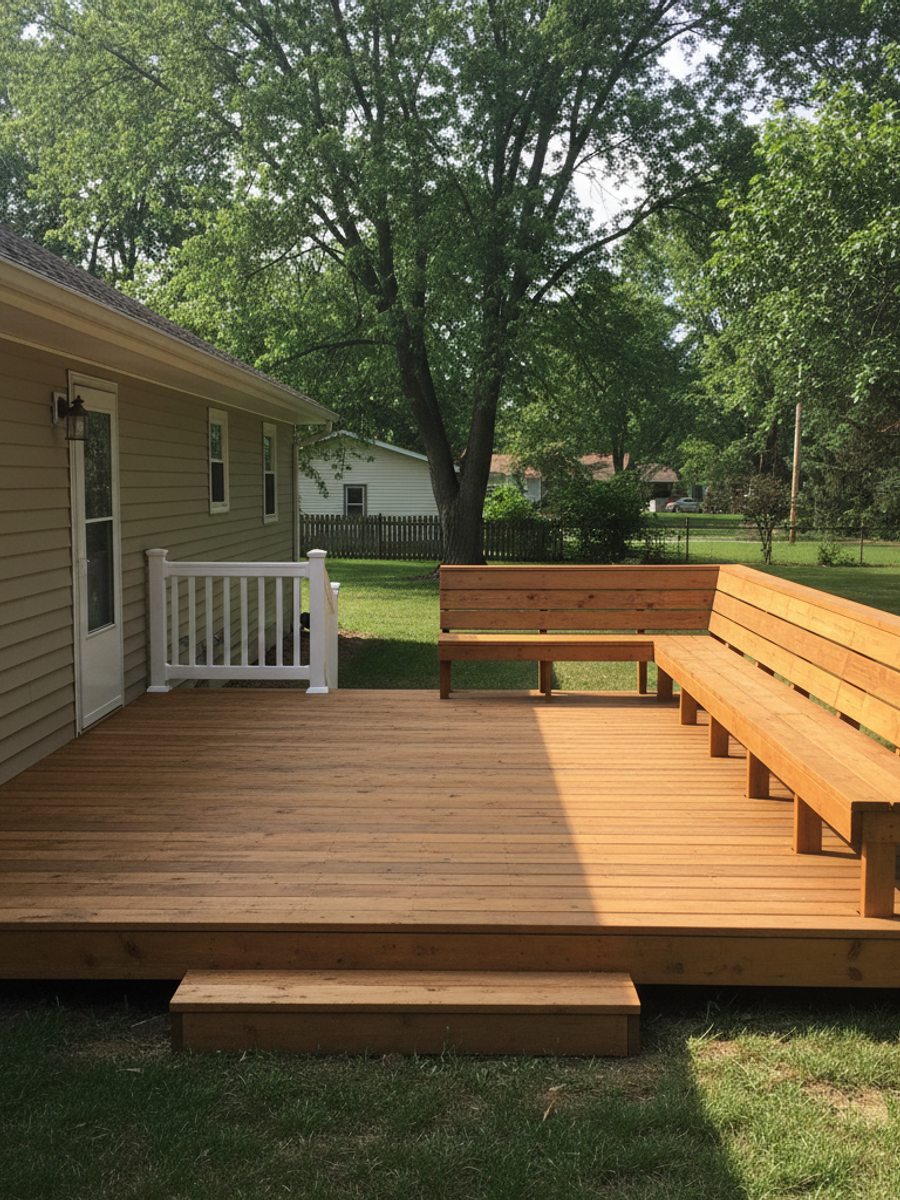
People ask this one a lot, usually in April when the snow just melted and they're standing on soggy ground looking at a rotten deck board. The honest answer depends on what part of the job you're talking about. Framing, staining, and footing work all have different windows here, and Fitchburg's climate makes some of those windows pretty narrow.
Frost depth decides when footings can go in
Wisconsin's Uniform Dwelling Code requires footings below the frost line, and in Dane County that's typically 48 inches. That's not a suggestion, it's what keeps a deck post from heaving six inches out of the ground every spring when the frozen soil underneath it expands and contracts. Digging a 48-inch hole in January in Fitchburg means digging through frozen ground on top of clay-heavy soil underneath, and it's miserable, slow work even with power equipment. Most builders stop digging footings sometime in November and don't start again until the ground softens, usually late March or April depending on the winter.
Spring itself isn't great either. Clay soil here holds water, and a thaw turns a backyard into something closer to a sponge for a few weeks. Pour a footing into a hole that's still weeping groundwater and you get a weak, honeycombed base. We'd rather wait two or three weeks for the yard to firm up than pour concrete into mud.
Lumber needs to dry out before it gets finished
New pressure-treated lumber comes out of the mill soaked with preservative and water. It has to dry before stain or sealer will actually bond to it, otherwise the finish sits on the surface and peels within a year. In Fitchburg's summer humidity, that drying can take four to eight weeks. In the dry, cool air of October it can happen faster. This is one reason a deck built in June often doesn't get stained until August or September, and that's correct, not a delay. If a contractor offers to stain brand-new treated lumber the week it's installed, that's worth asking about.
Framing itself is actually easier on the lumber in cooler weather. Pressure-treated joists and posts move less when the temperature isn't swinging forty degrees between a sunny afternoon and a clear night, which is exactly what happens here in late spring. A lot of experienced builders prefer September and October framing for that reason. The wood is more stable, the bugs are gone, and the ground is dry enough to work without tracking clay through the yard.
Staining has a real temperature window
Most exterior stains and sealers want surface and air temperatures between roughly 50 and 90 degrees Fahrenheit, with low humidity and no rain in the forecast for at least 24 hours before and after application. That rules out most of January through March outright. It also rules out the muggiest stretches of July and August, when a film can skin over on the surface before it's actually cured underneath. Late May through June, and then September into early October, are usually the cleanest windows in this area. Early fall tends to be the favorite because the bugs have died down and the humidity drops.
Re-staining an older deck is more forgiving timing-wise than finishing a brand-new one, since the wood is already dry. But the weather window is still the weather window. Stain applied in the wrong conditions doesn't fail right away, it fails the following spring when water gets under a finish that never cured properly.
Composite decking runs on a different clock
Composite boards don't need to dry out before anything gets done to them, so a lot of the lumber-moisture timing above doesn't apply. What does matter is thermal movement. Composite expands and contracts more than wood with temperature swings, and Wisconsin gives it plenty of those, sometimes a 50-degree range in a single October day. Gapping between boards has to account for whatever temperature it's installed at, tighter in summer, wider in cold weather, so the boards don't buckle or gap too far the other direction once the season changes. This is one reason composite installation is less weather-restricted than wood staining, but it's not weather-proof planning. A deck framed in July and decked in November needs different spacing than one built entirely in August.
Permits and inspections take longer than people expect
The City of Fitchburg's building inspection division issues permits for most deck work attached to the house, and anything with footings typically gets inspected at least twice, once for the footing holes before concrete goes in, and again for the framing before any decking or railing covers it up. If the lot backs up to a setback line or an easement, which is common in some of the newer subdivisions around the Nine Springs and Dunn's Marsh areas, that can mean a quick survey check before the permit gets approved. Older neighborhoods closer to the Fish Hatchery corridor sometimes have less documentation on file for the original lot lines, which can add a few extra days.
Spring is the busiest season for permit applications in most municipalities, simply because everyone wants to build the minute the snow's gone. Applying in late winter, even if construction doesn't start until the ground thaws, usually means the paperwork is already cleared by the time crews can dig.
So what's actually the best time
If you're building new, late summer through fall gives you dry ground, stable lumber, and a good staining window a few weeks later. If you're repairing rot or replacing a few boards, that can happen almost any time the ground isn't frozen. If you're just staining an existing deck, aim for a stretch of mild, dry days in late spring or early fall and skip the humid middle of summer. Demolition and removal don't really care about the calendar at all, which makes winter a decent time to get that part out of the way before the spring rush. For most of what Majestic Deck Solutions builds and repairs around Fitchburg, we plan the footing and framing work around the ground, and the finishing work around the thermometer, not the other way around.