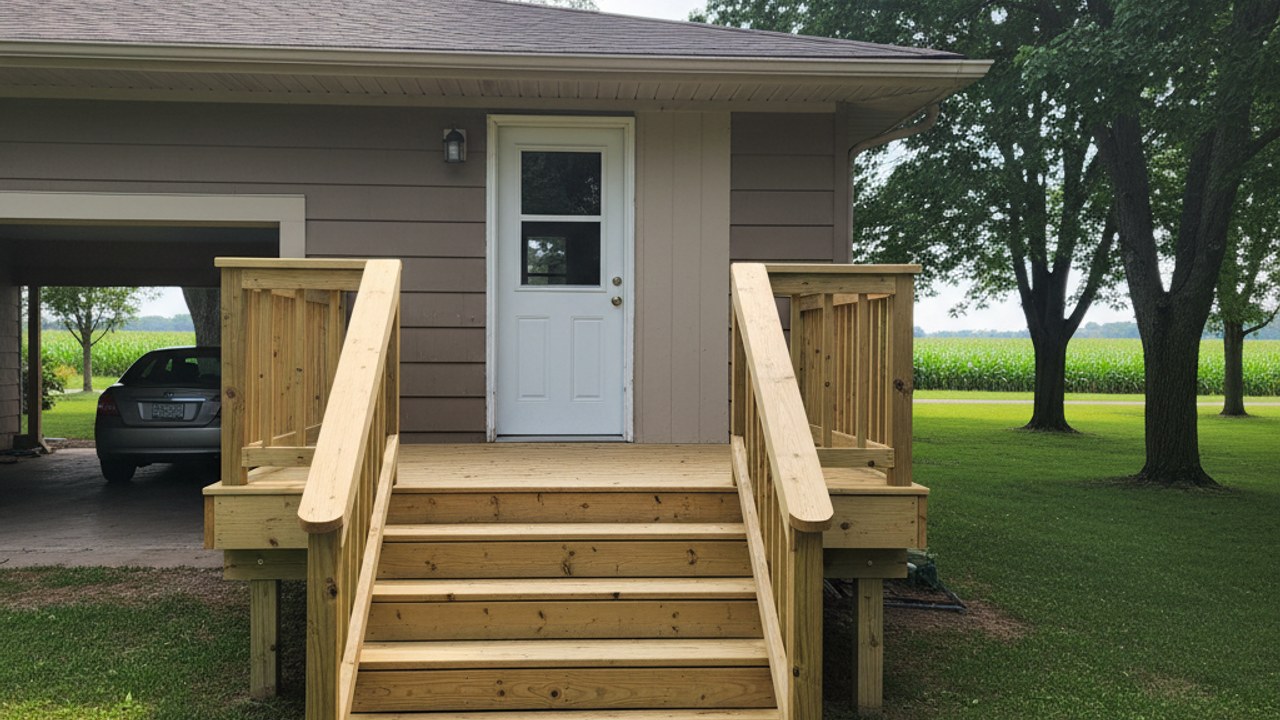
Most of the deck jobs that go sideways in Fitchburg don't go sideways because of the decking material. They go sideways because of something nobody looked at before the first post hole got dug. Clay soil that holds water against a footing. A ledger board bolted into a band joist that's already soft. A permit nobody pulled because the last owner's deck was "already there." None of that is dramatic, but all of it costs money later. Here's what's worth checking before you spend a dollar, whether you're putting in a new deck, resurfacing an old one, or tearing one down.
Start with what's under the lawn
Dane County sits on glacial till, which means a lot of Fitchburg lots have heavy clay a foot or two down, especially in the older sections near Lacy Road and the original township center. Clay swells when it's wet and shrinks when it dries, and a footing that isn't deep enough will move with it over a few winters. Frost depth around here runs close to 48 inches, and footings that don't go below that line are the single biggest reason decks heave or lean after five or six years. A few newer subdivisions, Swan Creek and parts of Nine Mound, sit on sandier ground that drains faster, which actually makes the footing work easier, but you still don't get to skip the depth.
- Ask what footing depth the crew is planning and why, not just "to code."
- Walk the yard after a heavy rain before the job starts. Standing water near the planned footprint tells you more than a soil map will.
- Call 811 for utility locates at least three business days out. Wisconsin's one-call system is free and it's the only way to know what's actually buried before anyone digs.
What's attached to the house matters as much as what's new
A deck isn't really a separate structure. If it's attached, it's hanging off your house through a ledger board, and that ledger is only as good as the band joist behind it. On homes built before the 1990s, especially the farmhouse-era properties scattered through the older parts of town, that band joist has sometimes seen forty years of condensation and no flashing at all. Pull back the siding before anyone drills, not after. If you're adding a screened porch with its own roof, the framing underneath has to carry Wisconsin snow load, which is a different calculation than a bare deck surface ever needs.
Flashing matters more than people think. A strip of aluminum or composite flashing between the ledger and the house wall is what keeps water from running behind the board and rotting the rim joist from the inside, where you can't see it until it's bad.
Permits and the paperwork nobody enjoys
The City of Fitchburg requires a permit for most attached decks and for any deck that sits more than 30 inches above grade, and the inspector wants to see the footings before concrete goes in, then come back for a framing check before the boards go down. Skipping that isn't just a risk if something fails. It becomes a real problem if you ever sell the house and the deck shows up unpermitted on an inspection report. If your lot backs up to a property line, a quick setback check against your plat saves an argument with a neighbor later. Several of the newer developments around Fitchburg, including parts of Seminole Highlands, have HOA rules on deck height, railing style, or even stain color, so it's worth a five-minute call before you pick materials.
If there's already a deck there
Resurfacing or tearing out an old deck is its own category of job, and it hides its own problems. Pull a board in a few spots and look at the joists underneath, not just the surface. Nail sickness, where old common nails corrode and back out over a few decades, is common on anything built before structural screws became standard. If the ledger on the existing deck was never flashed, chances are there's rot behind it even if the deck feels solid when you walk on it. A deck built in the 1980s or 90s was often framed to a lighter spec than current code calls for, so reusing the substructure under new composite boards isn't always the shortcut it looks like. Composite decking is heavier than wood per square foot, and an old frame sized for cedar doesn't automatically carry it.
The smaller things worth five minutes
None of these are dealbreakers on their own, but they add up to a cleaner job if someone checks them up front.
- Downspout location. If a gutter dumps right where the deck footing needs to go, that water has to be redirected before the concrete goes in, not after.
- Tree roots. Mature oaks and maples are common on older Fitchburg lots, and a root running through the footing zone changes where the post actually lands.
- Grading under the deck. Decks built low to the ground need a slight slope away from the house so water doesn't pool underneath and sit against the framing all summer.
- Stain and sealant timing. New pressure-treated lumber needs to dry out for a season before it'll take a stain properly, so if staining is part of the plan, that's a second visit, not a same-week finish.
Most of this comes down to the same idea: a deck is a structure sitting on soil that moves, attached to a house that's been settling for decades, in a climate that freezes and thaws the ground every winter. None of that shows up in a sales brochure for decking boards. We walk every site for these things before we write a quote, because catching a soft band joist or a shallow footing problem in week one is a lot cheaper than catching it in year five. If you want someone to look at your yard before you commit to a design, that's the kind of site visit Majestic Deck Solutions does as a matter of course, not an upsell.